Showing posts with label species. Show all posts
Showing posts with label species. Show all posts
Monday, 4 September 2017
Microplastic Findings in UK waters a Success
The last time I posted on here was to talk about the research i was carrying through about microplastics within the UK oceans and i can proudly say it was a success. I have put the results on my linked in page for any interested readers to take a look at (the link will be placed on this blog).
For many students whom read this blog and study at university or school, I hope it does help you as a quick study guide. I will be writing more frequently again as soon the summer is over for you all, i was having a break away from this myself.
As my dissertation showed the microplastics have been found in UK waters i have decided to go on to do further study within the area. I have already looked a micro marine wildlife being affected across the South-East Kent Coast therefore I starting to come more inland to look at urban areas to view where the main sources are coming from and compare management techniques. All of this will be done with the same university i was with in my undergraduate (Canterbury Christ Church University)
If you do have any question do feel free to get in contact as always! :) and the link below is my research paper, the link will direct you to linked in but go to the Canterbury Christ Church section and click on the Marine Pollution Bulletin.
The Potential effects of Microplastics on Biodiversity across the South East Kent Coastline
I am trying to get public funding with my further study due the equipment and material that have to be used in the effort to try and reduce the amount of plastic/Microplastic that mount up in the oceans. I have set up a go fund me page in the changes of funding. But my Research is driven more from passion, the love of helping the environment thrive and still stand in such a world that is man made now. I know as humans we don't realize are actions are making things bad for animals therefore there are other humans that pick up the pieces.
Save the Oceans Please

Thursday, 27 April 2017
The 3 Strategies of survial
K- Strategist
- Stable environments are labelled by species with a K-strategy
 |
Elephants are within the K -species as they rear for their young to induce a higher survival rate therefore most of their energy is placed into that instead of surviving the unstable conditions they have adapted to K-strategist.
Population levels tend to remain stable
(More related to mortality then environmental influences)
R- Strategist
These tend to be small, short-lived species. whom invest all their energy in producing more offspring then the K species, the population density can get low due to parental care being minimum.
|
 |
Mice are within the R-strategy as they have so many offspring that minimum care can be giving to all off the offspring from the mother therefore she actually produces a low density due to deaths at young ages.
A table showing the Differences between R and K; |
 |
Table show the differences between R and K
|
 |
The graph above shows lifespans of fish which is a R species therefore has a short lifespan but higher density (Blue line) and Dugongs which is a K species which population level tends to remain high therefore it lives longer (red line) Bet-Hedging
some spread their life histories over variables time periods, others respond to their environments by laying eggs and then moving on.
|
 |
the graph above shows how bet hedging works the growth of the plants is unpredictable by fitness as the plant is using mechanisms of change to survive in unpredictable circumstances. PESTS! - MAINLY R-STRATEGISTS. |
Reproductive stratgegy Theory of Pests
There is the theory that species adopt one of the 3 life strategies in order to survive in a stable and unstable environment.
either of the 3 strategies are below:
Therefore Pests need to adapt to the environments by inhabiting to one of the 3 strategies above.
Go to the next Post to Find out more on the Strategies
either of the 3 strategies are below:
- r-section
- k-selection
- bet-hedging
But, What is a Stable environment?
Well it is not the UK! Stable environments are those climates that are relatively constant or easily predictable in there weather and other areas as well for example the tropical rainforest has a constant temperature of around 5/6 degree and a known mist of fog. Therefore, this is a stable environment.
 |
| Temperature zones for the Rainforest live on the 27/04/2017 |
So, What is a Unstable environment?
This is more like the UK, it is an unpredictable environment which varies in it climates. as well as this there is disturbances in the temperature zones. |
| Temperature Zones for London showing rain in the evening live on 27/04/2017 |
Therefore Pests need to adapt to the environments by inhabiting to one of the 3 strategies above.
Go to the next Post to Find out more on the Strategies
Wednesday, 15 March 2017
General Homeostasis
Definition
Homeostasis is a control of internal conditions be it temperature, specific blood conditions or other variables within living organisms.


Homeostasis is a control of internal conditions be it temperature, specific blood conditions or other variables within living organisms.
CONTROL =procceds well only within narrow limits (Permitted by temp, enzyme/ Substance availability [Inc. gaseous exchange]; pH, osmolalrity
The term ‘Homeostasis’ was first defined by French Physiologist, Claude Bernard in 1865.
CONFORMERS;
Organisms whose internal conditions are controlled primarily by environment conditions.

Examples;
(Temperature Control) Thermoconformers; Most insects cannot control their internal body temperature to any great degree. Rather, their bodies are usually the same temperature as the environment.
(Salt Balance) Osmoconformers; Echinoderms (things like starfish, sea urchins etc), entirely lacking an excretory system, are strictly limited to marine environments, and their tissues have the same salinity as sea water.
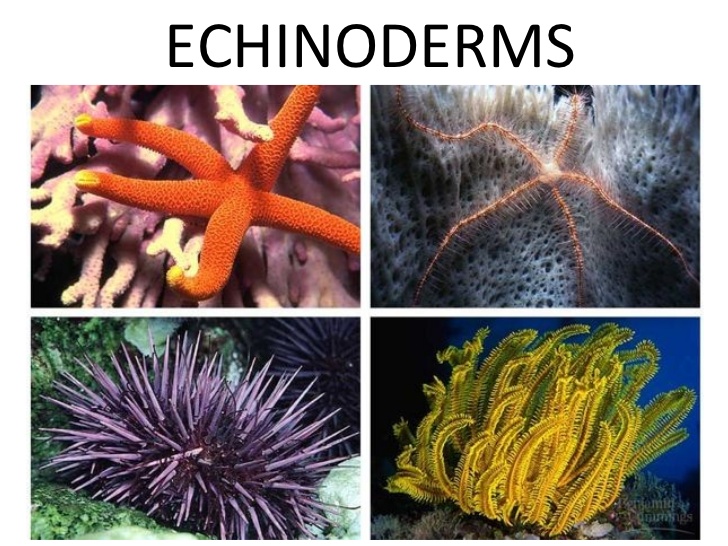 |
| Echinoderms |
Ectotherm; Obtains heat primarily from the environment
Poikilotherm; Temperature regulated primarily by environment
REGULATORS;
Organisms able to use metabolic means to regulate their internal environments in response to environmental changes
Example:
Thermoregulation (Temp. control);
Healthy mammals and birds are able to control their internal temperatures at very constant level.

Osmoregulation (Salt Balance);
- Some species of fish can migrate from salt to freshwater habitats every year with their breeding cycle (they’re called “anadromous” fish)
- Other species can migrate from freshwater to marine habitats every year with their breeding cycle (They’re called “Catadromous” fish)
These fish can maintain constant salt balance in their tissues via their renal system (Kidney and associated structures), even when their environment vary drastically in salinity.
Endotherm
Obtains heat primarily from metabolic reactions
Homeotherm
Temperature regulated primarily by internal homeostatic mechanism
Both Regulators and Conformers need to tolerances in various in environmental challenges within and among species.
Short term responses to environmental changes are known as ADAPTIONS. These are governed by the internal control (homeostatic) mechanisms in the individual, but the limits are set by the Evolutionary History of that individual.
Individual Adaptions may include;
- Physiological Acclimation
Some species are able to Physiologically ACCLIMATE (Gradually change their tolerance levels) in a slowly changing environment, but this ability to is controlled by genes that have been selected over evolutionary time
- Morphological Change
Morphology may change in response to environment (Consider coat change; shape change of Crustaceans to environment)
- Behavioural Adaptation
Behavioural Adaptation allow an animal to respond relatively quickly environmental challenge.
What happens if the Environment changes too rapidly for adaption to evolve?
- Endangered species
- Victim to Climate change
- Wiped out
Homeostasis Process in Animals;
- Osmotic potential of blood waste/excretion (e.g. nitrogenous wastes)
- Chemical constituents of blood/ other tissues and organs (lipids/ sugars- glycogen/ ions (Na+ and K+), pH, Blood Volume/ Pressure
- Gaseous Exchange
- Temperature
- Hormones for reproductive/ Digestion
Negative Feedback loops;
- Direction of compensation is opposite to direction of disturbance
 |
Examples;
- Control of blood pressure
- Blood sugar concentration
- Heat response
- Cold Response
Positive Feedback loops;
- Compensation increases the level of disturbance = amplified response
 | |||
 | |||
Feedforward;
Information serves to alter the set point in regulatory systems. An example might be changes in set point due to accumulation.
- Sexual behaviour – Ejaculation
- Birth
- Urination
- Filling body cavities – Digestion
Some Systems need both Pos +Neg *Human Ovarian+Uterine cycles, ESTROGEN levels unbalanced.
@Science_nerd101 (Twitter)
Subscribe to:
Posts (Atom)