Homeostasis is a control of internal conditions be it temperature, specific blood conditions or other variables within living organisms.
CONTROL =procceds well only within narrow limits (Permitted by temp, enzyme/ Substance availability [Inc. gaseous exchange]; pH, osmolalrity
The term ‘Homeostasis’ was first defined by French Physiologist, Claude Bernard in 1865.
CONFORMERS;
Organisms whose internal conditions are controlled primarily by environment conditions.

Examples;
(Temperature Control) Thermoconformers; Most insects cannot control their internal body temperature to any great degree. Rather, their bodies are usually the same temperature as the environment.
(Salt Balance) Osmoconformers; Echinoderms (things like starfish, sea urchins etc), entirely lacking an excretory system, are strictly limited to marine environments, and their tissues have the same salinity as sea water.
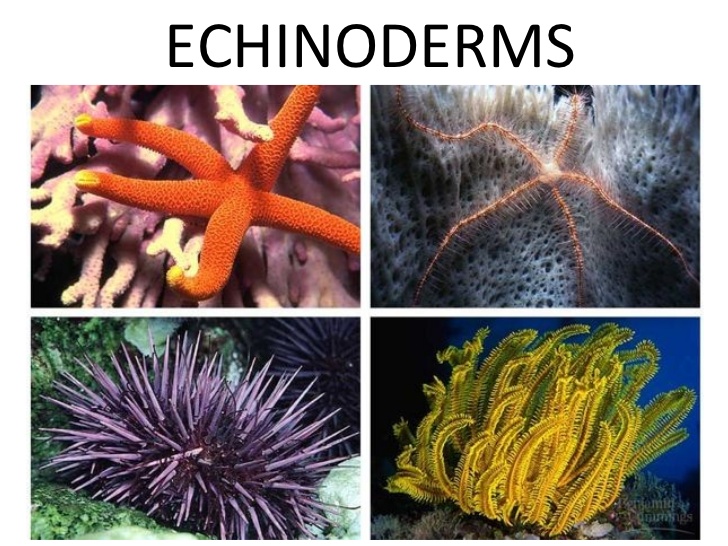 |
| Echinoderms |
Ectotherm; Obtains heat primarily from the environment
Poikilotherm; Temperature regulated primarily by environment
REGULATORS;
Organisms able to use metabolic means to regulate their internal environments in response to environmental changes
Example:
Thermoregulation (Temp. control);
Healthy mammals and birds are able to control their internal temperatures at very constant level.

Osmoregulation (Salt Balance);
- Some species of fish can migrate from salt to freshwater habitats every year with their breeding cycle (they’re called “anadromous” fish)
- Other species can migrate from freshwater to marine habitats every year with their breeding cycle (They’re called “Catadromous” fish)
These fish can maintain constant salt balance in their tissues via their renal system (Kidney and associated structures), even when their environment vary drastically in salinity.
Endotherm
Obtains heat primarily from metabolic reactions
Homeotherm
Temperature regulated primarily by internal homeostatic mechanism
Both Regulators and Conformers need to tolerances in various in environmental challenges within and among species.
Short term responses to environmental changes are known as ADAPTIONS. These are governed by the internal control (homeostatic) mechanisms in the individual, but the limits are set by the Evolutionary History of that individual.
Individual Adaptions may include;
- Physiological Acclimation
Some species are able to Physiologically ACCLIMATE (Gradually change their tolerance levels) in a slowly changing environment, but this ability to is controlled by genes that have been selected over evolutionary time
- Morphological Change
Morphology may change in response to environment (Consider coat change; shape change of Crustaceans to environment)
- Behavioural Adaptation
Behavioural Adaptation allow an animal to respond relatively quickly environmental challenge.
What happens if the Environment changes too rapidly for adaption to evolve?
- Endangered species
- Victim to Climate change
- Wiped out
Homeostasis Process in Animals;
- Osmotic potential of blood waste/excretion (e.g. nitrogenous wastes)
- Chemical constituents of blood/ other tissues and organs (lipids/ sugars- glycogen/ ions (Na+ and K+), pH, Blood Volume/ Pressure
- Gaseous Exchange
- Temperature
- Hormones for reproductive/ Digestion
Negative Feedback loops;
- Direction of compensation is opposite to direction of disturbance
 |
Examples;
- Control of blood pressure
- Blood sugar concentration
- Heat response
- Cold Response
Positive Feedback loops;
- Compensation increases the level of disturbance = amplified response
 | |||
 | |||
Feedforward;
Information serves to alter the set point in regulatory systems. An example might be changes in set point due to accumulation.
- Sexual behaviour – Ejaculation
- Birth
- Urination
- Filling body cavities – Digestion
Some Systems need both Pos +Neg *Human Ovarian+Uterine cycles, ESTROGEN levels unbalanced.
@Science_nerd101 (Twitter)

